
The war in Ukraine has become the epicentre for an evolution in modern warfare. Heed the lessons or learn them the hard way in the next war! ⬇️
Center for Strategic and International Studies (CSIS) has an insightful report on Russia’s rapid evolution of drone warfare and nascent military artificial intelligence capabilities.
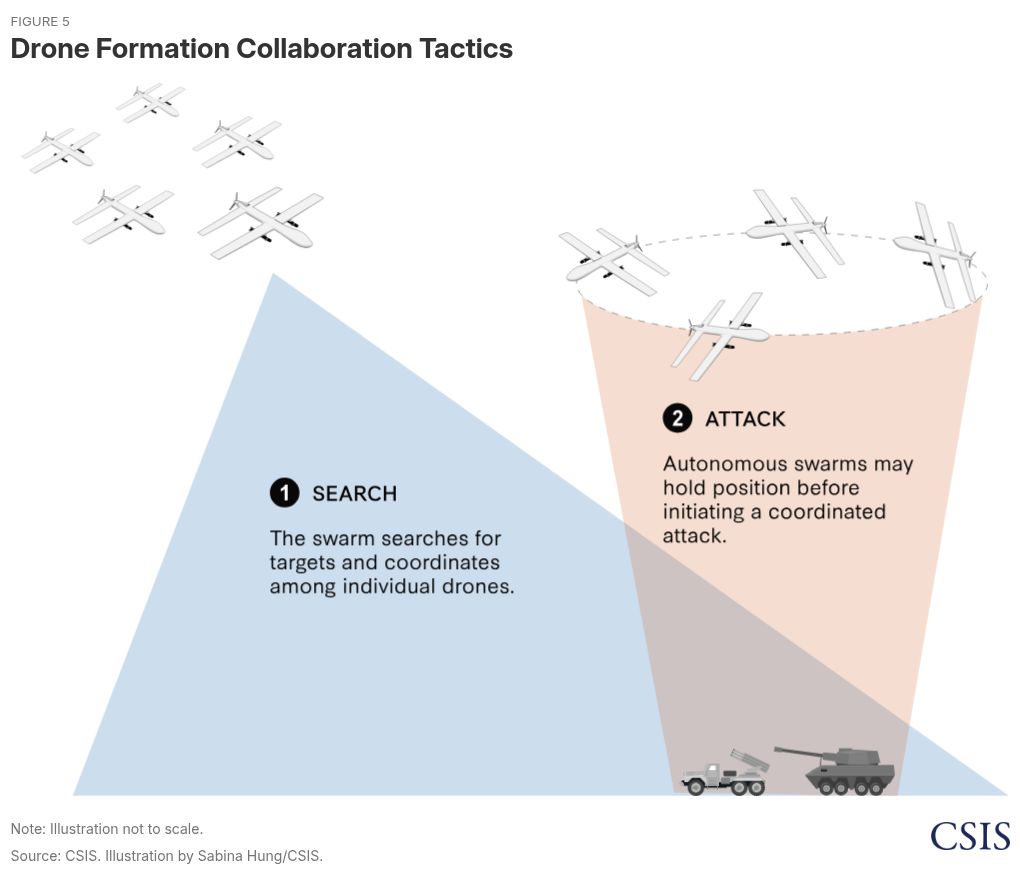
The report documents a May 2025 incident where seven V2U loitering munitions appeared to deviate from their mission after detecting a concentration of vehicles and civilians, formed a circular holding pattern, and then initiated coordinated attacks. This wasn’t remotely piloted behaviour and intercepted V2Us indicates an absence of components required for operator control and significant onboard compute:
“Observed battlefield behavior—including autonomous flight in denied environments, independent target selection, and coordinated group activity using visual markings for swarm-like coordination—suggests that V2U represents a qualitative departure from remotely piloted expendable drones toward fully autonomous, AI-driven systems.”
Like Ukraine, Russia’s drone ecosystem is leveraging innovation from outside of Defence Industry. Rapid experimentation by small groups at the ‘garage level’ is being coupled with the state picking winners and rapidly scaling up systems that prove operationally effective. Battlefield lessons are fed back to allow iterative evolution and improvement to improve effectiveness and efficiency.
The final takeaway we’ll highlight is the importance of Dual-use companies and not simply priortising Primes. The report assesses that companies that are best integrating AI into drone systems are all companies that operate across military and civilian markets:
“Dual-use firms can draw on far larger and more varied datasets, iterate software in real operational environments, and continuously retrain models based on civilian and security applications. This access to data, testing opportunities, and feedback loops allows AI capabilities to mature faster and transition more smoothly into battlefield use than systems developed exclusively inside closed military programs.”
In the crucible of conflict, a brutal adaption cycle that seen Russia identify and embraced the small, the smart and the many. Often learning from the successes of Ukraine, Russia has leveraged the partial mobilisation of its national resources to mount a national project to accelerate development, introduction into service and rapid improvement of a range of drones.
So much food for thought – particularly when reflecting on Australia’s approach to drones as updated in the latest National Defence Strategy. We can’t afford to not leverage the lessons of modern warfare – we owe it to our soldiers are facing their first drone threat in combat.
📷 via and Link to this excellent Center for Strategic and International Studies (CSIS) Report is in the comments.