
The world is relearning how difficult it is to reconstitute when war is large and long. Being ready for war is more than being ready to fight tonight. ⬇️
The constraints of war are not new. Shell hunger, insufficient food & fibre and manpower shortages are all challenges Ukraine and Russia are facing as we speak. Missile magazine depth is starting to shape decisions by the United States against Iran. In an era where large scale war has returned, the ability to repair and replace a nation’s military is just as important as being ready to fight tonight. This is why a recent article in the Military Review on ‘Reconstituting Combat Power in Large Scale War’ caught our attention:
“For the past twenty years, the US Army has built its force around predictable rotations and limited wars. Large-scale combat operations, with their corresponding high casualty rates, received limited attention. But Russia’s invasion of Ukraine changed that. It revalidated that modern combat consumes people, materiel, and munitions at rates that can break formations. It reminded the world that armies can break under pressure, and they must find ways to rebuild while fighting, a process called reconstitution.”
It has been a long time since the Australian Defence Force considered large scale mobilisation and growth of the force, let alone reconstitution of force elements that have been rendered combat ineffective or attritted.
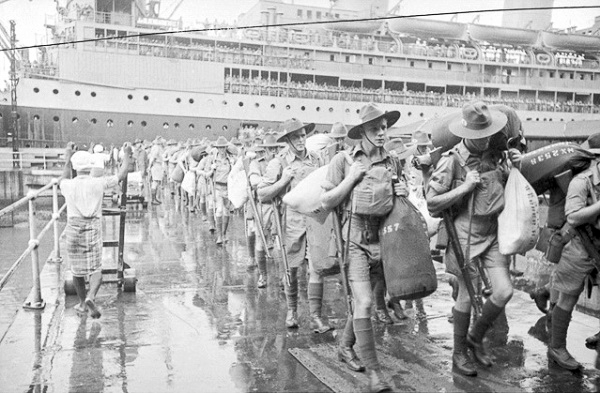
The 8th Division is perhaps the most salient example of the demands of large and long war. This Division was deployed to key locations in the Indo Pacific littoral to defend Japan’s attempt to project power against Australia through our northern approaches. Mere months after Pearl Harbour, the Division had been defeated and the vast majority personnel captured or killed in fierce fighting. A Division removed from the order of battle, a nation urgently scrambling to reconstitute forces to defend the homeland.
This Division was ~ 20,000 personnel. Reconstituting the workforce alone makes the challenge clear. The entire Australian Defence Force has not seen an annual intake of recruits of that size since Vietnam. Is our recruiting system ready for scale? What about recruit training, administration and logistics? Some of the recommendations from the Military Review article are just as applicable for Australia as they are for the United States:
“Doctrine alone cannot prepare the force to regenerate while fighting. Reconstitution must be practiced in exercises, simulations, and theater-level experiments that stress commanders and staffs… The Army should lead a campaign of learning that tests reconstitution as an operational function integrated with strategic commands and capabilities. Measures of effectiveness should include time to rebuild a brigade, percentage of combat systems recovered, and degree of unit cohesion retained”
Food for thought as always.
📷 Elements of 8th Division arriving in Singapore, 1941.